Childcare Subsidy Enrollment Income Generosity and Child Maltreatment
 Open full-size image
Summary
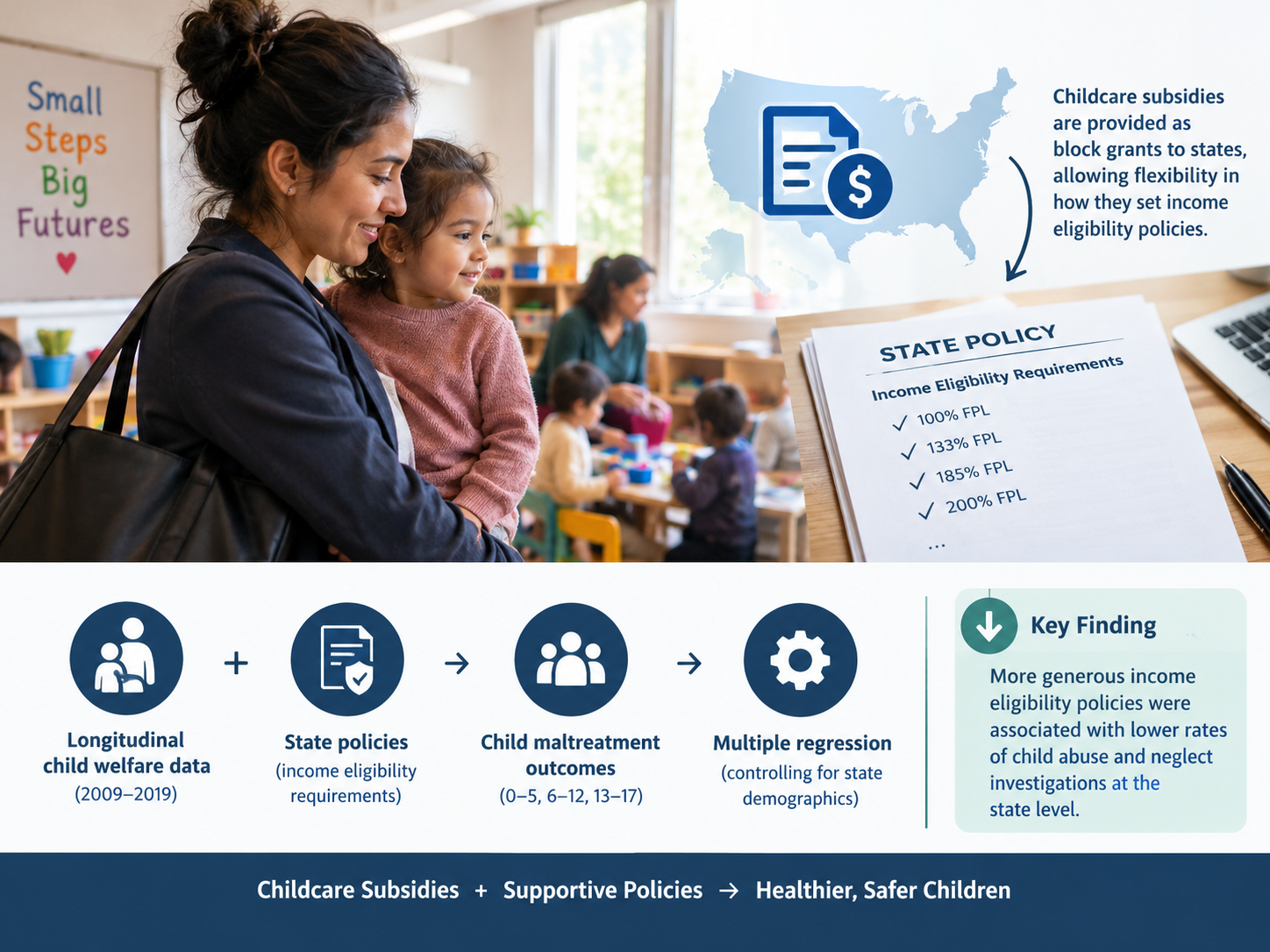
This study examined how state childcare subsidy income-eligibility policies relate to child maltreatment rates. Findings showed that more generous income eligibility policies were associated with lower rates of child abuse and neglect investigations, highlighting the potential for childcare assistance policies to support child and family well-being.
Topics: Child Maltreatment Prevention, Public Assistance Policies (TANF, SNAP, and EITC), Socioeconomic Policy and Financial Wellbeing
Contributing Lab Members


Abstract
In the United States, childcare subsidies are available to low-income working parents to assist with the cost of childcare. The subsidies are provided as block grants to states, which allows for a great deal of flexibility in the specific policies guiding their distribution. Prior research has found a protective link between childcare subsidies and child maltreatment, but the variations in policies have been much less explored. The current study used longitudinal administrative child welfare data from 10 years (2009-2019) linked with state policies regarding the income eligibility requirements of states to examine the impact of these policies on child abuse and neglect among young children (0-5); early school-age children (6-12), and older children (13-17). Using multiple regression and controlling for state demographic characteristics, the study found that more generous policies surrounding income eligibility were related to lower rates of child abuse and neglect investigations at the state level.
Citation
Study at a Glance
Purpose of childcare subsidies
Help low-income working parents afford childcare.
State policy differences
States have flexibility in setting income eligibility requirements for childcare subsidies.
Research gap
Previous studies found a link between childcare subsidies and lower child maltreatment, but differences in state policies have received less attention.
Study objective
Examine how state income eligibility policies relate to child abuse and neglect investigations.
Data and methods
Analyzed child welfare data from 2009–2019, linked with state policies, using multiple regression and controlling for state demographic characteristics.
Age groups studied
- Young children: ages 0–5
- Early school-age children: ages 6–12
- Older children: ages 13–17
Key finding
States with more generous income eligibility policies had lower rates of child abuse and neglect investigations.
Implication
Expanding eligibility for childcare subsidies may be a promising policy approach to support families and help prevent child maltreatment.